Showing posts with label talk moves. Show all posts

Tuesday, 23 August 2016

Maths- Connections and Communication


Maths is a connected subject, but some students think of it as disconnected and isolated  from other subjects. Such students who believe that maths is a set of formulas that have to be remembered is associated mainly with low achievement. 

We use talk moves all the time in class. It allows us to communicate about the topic that we are learning. Since I have started using talk moves, I have noticed that my students are making more meaning of this subject and are becoming enthusiastically engaged in their learning of Maths. 

Today I gave simple multiplicative problems to my students. They had to solve the problems mentally and also explain how they had come to a conclusion. I noticed that some of the students could work out the correct answer but were not able to explain their thinking. One of the girls is very new to New Zealand and can speak only Samoan. There were others who felt intimidated and not so confident sharing their ideas in a large group.  

I wanted to honour these students who had solved the problem but were not able to explain their thinking. So I gave them time to think about mathematics. I put them into groups and gave them an opportunity to think and talk about what worked and what went wrong.

Students felt more comfortable in smaller groups and they could find a way to connect or ask questions about the parts that may be confusing or difficult to follow. 

During sharing time, almost all students in this group could contribute a little to explain their working. I was elated to see that each student who never contributed could gather courage to say something little. Though they were not very explicit but I think it was a huge effort on their part.
 Yes! I thought, 'Little steps at a time can make a difference'. 


Saturday, 1 August 2015

Student Reflections


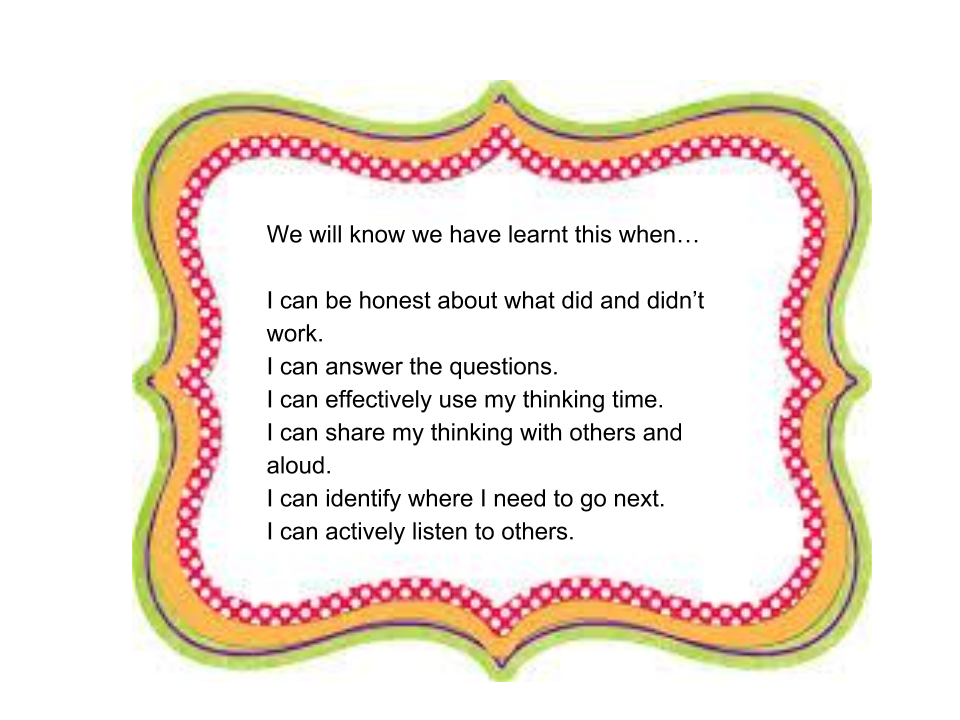
We have been learning to reflect on our learning in Room 5. It needs a bit of teaching to show students how to be reflective. I know that reflective process does not come all by itself. I have myself learnt to be a reflective teacher over the years. My students were learning and solving problems in class but I needed to take their learning further, by making them think metacognitively about the strategies they were using to solve problems. I wanted them to know and discover and identify for themselves, ‘where to next’ in their learning. As I have said earlier, one has to get trained to become reflective so I started by asking some simple questions of my students, for example:
What were you learning and why?
   What were the tricky bits and why?
   What new did I learn today?
   What helped the learning to happen?
   Who needs more help and what needs to be re-taught?

I had to convince my students that all learning is difficult and it is all good to share your experience of learning with others. It is an opportunity to discuss how one solved the problem and to learn from others the strategies they have used to solve the same problem.
“Metacognition is what people know or think about their own thought processes and is the individual monitoring of one’s own thoughts.” (Hacker & Dunlosky, 2003)
In the beginning students were very hesitant and became conscious as they talked about their thinking process. It was difficult for some of them to put it into words because of limited English. For such students I developed some sentence starters that they could use to share their strategies. Slowly, the more confident ones set examples for others and more and more students started to participate. As students started sharing their thinking process, it made me aware of the strategies that my students were using to solve problems. Students benefitted from listening to each other as they got ideas from each other. Reflection for students worked for my students to consolidate their learning, to recap on the ‘why’ of the learning, to give students opportunities to discuss strategies for learning, and possible ‘tricky’ bits and to establish a ‘where to from here’. I would not say that at this stage I have all my students participate in the reflective process. It is just the beginning…
Being Reflective.png
adapted from: www.minedu.govt.nz


Student prompt cards for identifying where they are at with their learning.


1. I really need help.
2. I understand bits and pieces.
3. I get it and can work by myself.
4. I can do my work and can help someone else if needed.